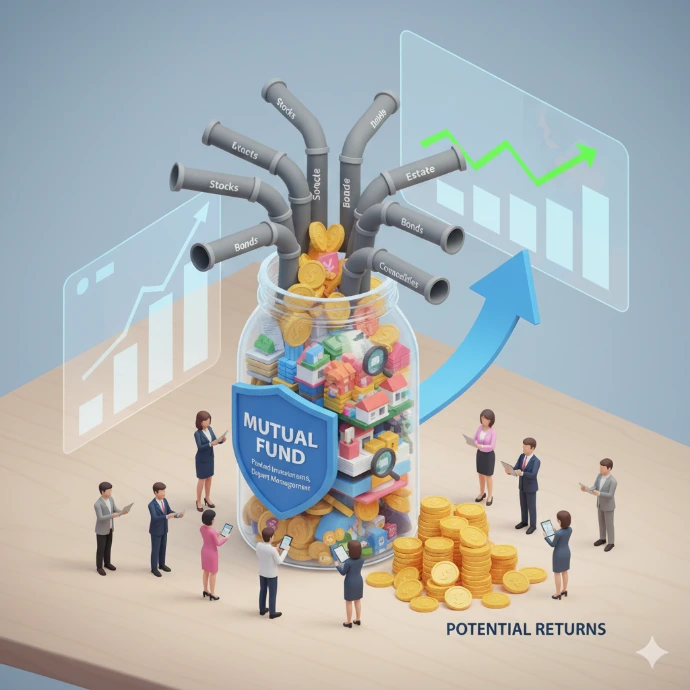
MUTUAL FUND
How It Works (The Simple Version)
Pooling: Thousands of people contribute small amounts of money.
Professional Management: A fund manager (an expert) decides which companies to invest in based on the fund's goal.
Units: In exchange for your money, you get "units" of the fund.
Shared Results: If the companies the fund bought make a profit or grow in value, the value of your units goes up. If they lose value, your units go down.
Why People Use Mutual Funds
Instant Diversification: If you have $100, you might only be able to buy one share of a small company. In a mutual fund, that same $100 gives you tiny "slices" of hundreds of different companies. If one company fails, the others protect you.
Low Cost: You can start with a very small amount (often as low as $10 or $50) through a Systematic Investment Plan (SIP).
Expertise: You don't need to spend hours researching balance sheets; the fund manager does that for you.
The 3 Main Types of Mutual Funds
Depending on your "Risk Appetite," you can choose different types of buckets:
| Type | What they buy | Risk Level | Best For... |
| Equity Funds | Primarily Company Stocks | High | Long-term wealth (5+ years). |
| Debt Funds | Government & Corporate Bonds | Low to Moderate | Stable returns and safety. |
| Hybrid Funds | A mix of Stocks and Bonds | Moderate | A balanced approach. |
Key Terms to Know
NAV (Net Asset Value): Think of this as the "price tag" for one unit of the fund. It changes every day based on how the underlying investments performed.
Expense Ratio: A small annual fee (usually 0.5% to 2%) that the fund company takes to pay the manager and run the fund.
Exit Load: A fee some funds charge if you take your money out too early (e.g., within the first year).
Important Note: While mutual funds are generally safer than picking individual stocks, they are not guaranteed. Their value goes up and down with the market.

HOW MUTUAL FUND IS GOOD
1. You Don’t Have to Be an Expert (Professional Management)
The biggest benefit is that you don't need to spend hours reading financial news or analyzing company balance sheets.
The Expert Advantage: A professional Fund Manager (who has years of experience and a team of researchers) does all the hard work of picking which stocks to buy and when to sell them.
Active Monitoring: They constantly watch the market and rebalance the "bucket" of stocks so you don't have to.
2. Instant Safety (Diversification)
There is a famous saying in finance: "Don't put all your eggs in one basket."
The Stock Risk: If you buy only one company's stock and that company fails, you lose everything.
The Mutual Fund Safety Net: A mutual fund might hold 50 to 100 different companies. If two or three of those companies perform poorly, the other 47 can still make you a profit. This dramatically reduces your risk of a total loss.
3. Start Small, Grow Big (Affordability)
You don't need thousands of dollars to start.
SIP (Systematic Investment Plan): You can start with as little as $10 or $50 a month.
Economies of Scale: Because the fund pools money from millions of people, it can buy expensive stocks (like Google or Amazon) that you might not be able to afford a full share of on your own.
4. It’s "Hands-Off" Wealth (The Power of Compounding)
Mutual funds are designed for the long term.
Auto-Reinvestment: Most funds have a "Growth" option where any dividends or profits are automatically reinvested. This creates a snowball effect where you earn money on your original investment, AND you earn money on your previous earnings.
Disciplined Habits: Setting up a monthly transfer to a mutual fund builds a habit of saving before you have a chance to spend the money.
5. Easy Access to Your Money (Liquidity)
Unlike real estate (which can take months to sell) or some fixed deposits (which have penalties for early withdrawal), most mutual funds are liquid.
Quick Cash: In most cases, if you need your money, you can sell your units and have the cash in your bank account within 1 to 3 business days.
Summary Table: Why Choose a Mutual Fund?
| Feature | Why it helps you |
| Low Barrier | You can start with very little money. |
| Diversified | Your risk is spread across many companies. |
| Regulated | In most countries (like the US or India), strict laws protect you from fraud. |
| Goal-Oriented | There are specific funds for retirement, buying a house, or saving for college. |
Pro Tip: If you are young, look for Equity Index Funds. They have very low fees and historically provide great long-term growth by simply tracking the top 500 companies in the market.
MOST IMPORTANT TOPIC'S FOR MUTUAL FUND
1. Core Evaluation Metrics
When looking at a fund's performance, professional investors look at these four "hard numbers":
Expense Ratio: The annual fee the fund charges. A high ratio (over 1.5%) can eat away at your profits over 20 years.
Net Asset Value (NAV): The "per unit" price of the fund. While a low NAV isn't necessarily "cheap," tracking its growth tells you how well the fund is doing.
Alpha & Beta: * Alpha shows how much the fund beat its benchmark (higher is better).
Beta measures volatility; a beta of 1.2 means the fund is 20% more volatile than the market.
Sharpe Ratio: This tells you if the fund's returns are due to smart investing or just taking excessive risk. A higher Sharpe ratio is better.
2. Investment Modes: SIP vs. Lumpsum
How you put your money in matters as much as where you put it:
SIP (Systematic Investment Plan): You invest a fixed amount every month. This uses Rupee Cost Averaging, meaning you buy more units when prices are low and fewer when prices are high. It is the best way for beginners to start.
Lumpsum: Investing a large amount all at once. This is better when the market has recently crashed and prices are low.
3. Fund Categorization (SEBI/Regulatory Classes)
Funds are grouped by what they buy. You must match the category to your goal:
Market Cap: Large-cap (stable, big companies), Mid-cap (growth), and Small-cap (high risk, high reward).
Thematic/Sectoral: Funds that only buy one industry (e.g., Technology or Healthcare). These are risky because if that industry fails, your whole fund fails.
Index Funds: These don't try to "beat" the market; they just copy it (like the Nifty 50 or S&P 500). They usually have the lowest fees.
4. Exit Strategy & Costs
Exit Load: A fee charged if you withdraw your money too early (usually within 1 year). Always check this before investing.
Lock-in Period: Some funds, like ELSS (Tax Saving Funds), lock your money for 3 years. You cannot touch it during this time.
5. Tax Implications (2025 Context)
Profit from mutual funds is called Capital Gains.
STCG (Short Term): High tax on profits if you sell within 1 year (for equity).
LTCG (Long Term): Lower tax rate on profits if you hold for more than 1 year. In many regions, the first $1,200 (₹1.25 Lakh in India) of profit is tax-free every year.
Summary Checklist for Choosing a Fund
| Topic | What to look for |
| Past Performance | Has it consistently beaten its benchmark over 5+ years? |
| Fund Manager | Has the same person been running the fund for a long time? |
| Portfolio Turnover | Does the manager trade too often? (Higher turnover = higher costs). |
| AUM (Assets Under Management) | Is the fund big enough to be stable, but not so big that it's "heavy"? |